The Dhol
Wood, Skin, and Soul

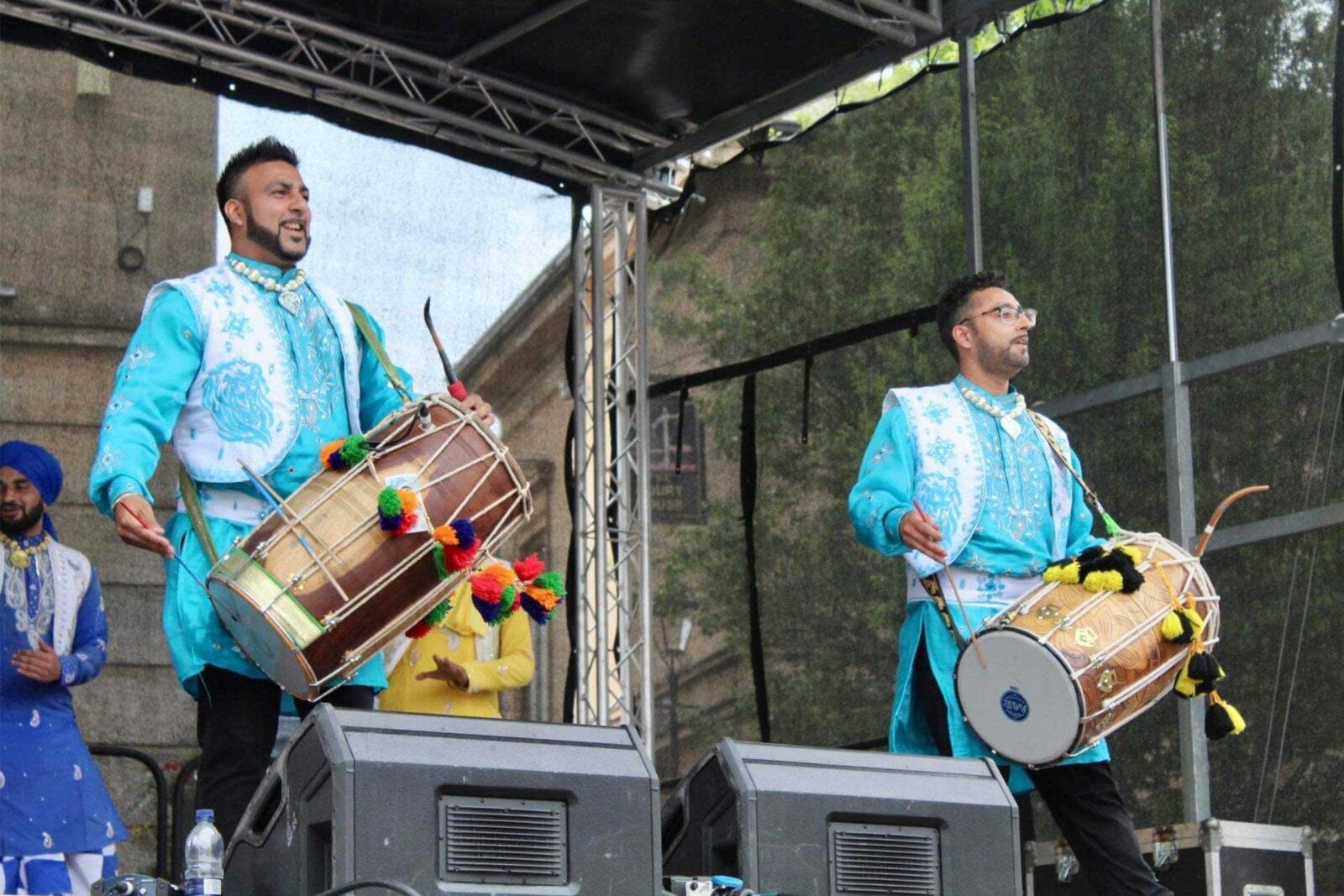
I first heard the dhol at a cultural showcase on the infield of our local racecourse. It was a summer mela of sorts, with food stalls and brightly dressed dancers, but all my attention zeroed in on that drum. The dhol’s bass notes thudded in the air like giant footfalls – I imagined an elephant walking in time to the music. Each deep boom rattled through the grass and grandstand, as palpable as distant thunder. Then came the sharp, syncopated cracks of the treble side, trumpeting over the bass, a playful counterpoint that reminded me of an elephant’s lively trunk call. In that moment, the dhol became in my mind “the elephant of musical instruments.” It was massive in sound, commanding and majestic, yet oddly endearing. I was a little awestruck, picturing a sound-monster elephant lumbering amid the crowd, each strike of the drum a heavy footstep or a jubilant trumpet.
I remember how the crowd responded. A circle of bhangra dancers had formed on the grass, feet kicking and arms whirling to the dhol’s pulse. Even spectators couldn’t help but tap their feet. I felt the vibrations in my own chest, the rhythm syncing with my heartbeat, stirring something primal and joyful. There was a paradoxical gentleness to the experience too – for all the dhol’s volume, it didn’t scare me; instead it drew me in. I found myself smiling at the sheer delight of it. It was as if that drumming was a friendly giant inviting us to dance. The memory of those elephantine beats echoing across an English racecourse sticks with me years later. In the moment, I knew little about the instrument itself, yet it spoke to me in a language older than words. Only later would I learn just how far those vibrations had travelled through history to reach me that day.
The dhol is a double-sided barrel drum originating from the Punjab region of India and Pakistan. It has ancient roots in South Asia, used in regional folk music for centuries. The word “dhol” itself comes from the Sanskrit ḍhola, meaning drum. Some speculate that percussion instruments resembling the dhol existed in the Indus Valley civilization over 4,000 years ago, hinting at a lineage as old as the earliest cities. While we can’t say for sure how the first dhol sounded, we do know it has been around a very long time. By the Mughal era, the dhol had made its mark – the 16th-century Mughal Emperor Akbar the Great even kept dhols in his royal orchestra, and the instrument was referenced in written records of that period. Historians believe it may have been introduced to South Asia by Persian or Central Asian influences – the Persian drum dohol is a likely ancestor. So the dhol as we know it today is a product of cultural exchange, evolving over generations into Punjab’s iconic rhythm keeper.
Physically, a dhol is as hefty as it sounds. The drum has a wooden barrel body with goat-skin or synthetic skins stretched tightly on both ends. Each side produces a distinct voice: the larger drumhead yields a deep, booming bass, and the smaller head produces a crisp, higher-pitched tone. Dhol players – called dholis – sling the drum over their shoulder with a strap and strike both ends with sticks. Traditionally one stick is thick and slightly bent (often called a dagga) for the bass side, and the other is thinner (tilli) for the treble side. The result is a dynamic two-toned beat that marries low thunder with high crackle. Listening back to the memory of that day, I now recognise why I heard elephant footsteps and trunk calls: the dhol was literally speaking in two voices. Its dual heads were performing a rhythmic duet – heavy and light, earth and sky. This unique construction has made the dhol beloved for its ability to drive music with both power and agility.
Over time, the dhol became deeply embedded in the culture of South Asia. It was traditionally played during harvest festivals, religious fairs, and weddings, often symbolising joy and communal spirit. In the Punjab region especially, the dhol grew into more than a drum – it became the heartbeat of an entire way of life. Punjab’s agrarian communities developed folk dances to the dhol’s rhythms. Foremost among these is Bhangra, a lively dance that originally celebrated the spring harvest (the festival of Baisakhi). As far back as the 1800s, farmers would finish their season’s work and erupt into dance, the dhol leading the celebration with its pulsating beat. Bhangra music and the dhol are inseparable; one early description simply noted that bhangra was performed to “the beat of the dhol”. Even today, across Punjab (in both India and Pakistan), Bhangra dancers—men and women, amateurs and professionals alike—move to traditional dhol rhythms that have been passed down like family recipes. The folk songs (boliyan) they sing are buoyed by the dhol’s pattern, and the dancers’ feet mirror the drum’s kicks and off-beats. During Baisakhi in particular, when the wheat is golden and ready, the sound of dhol fills villages as people literally dance in the fields, thankful for the bounty. The “elephant” drum announces that it’s time to rejoice and give thanks.
Beyond the farmlands, the dhol also found its place in spiritual and martial traditions. In Sikh and Punjabi culture, it was used to rally warriors in historic battles and to accompany religious processions. Meanwhile, Sufi mystics adopted the dhol for devotional music – a practice that continues in some shrines. Every Thursday night at the tomb of the Sufi saint Shah Jamal in Lahore, Pakistan, devotees gather for a dhol-driven trance ceremony. Under open skies, drummers like the late Pappu Sain pound out sinuous rhythms that build and build until the crowd enters a state of ecstatic dance. The air fills with dust, rosewater, and music; the distinction between drummer and dancer blurs into one collective heartbeat. It’s said that Shah Jamal himself, back in the 16th century, used the dhol and ecstatic dancing to spread his message. Hearing about this, I can’t help but marvel, the same type of drum that gave me goosebumps at a racecourse in Newbury is used half a world away to induce spiritual ecstasy in a shrine. The contexts could not be more different, yet the fundamental experience – humans moved by rhythm – is oddly similar.
It’s a curious thing to review an object that is so much more than an object. The dhol is wood, metal, and skin – but it is also history and heart. It carries the weight of generations while still compelling us to leap into motion right now, in the present. I think about the layers of meaning packed into each beat: a farmer’s prayer for good harvest; a grandmother’s memory of dancing in her youth; a diaspora kid’s first time feeling proud of his heritage; my own surprise and delight hearing an “elephant” make music. The dhol’s sound manages to be deeply rooted and yet immediately infectious to anyone who hears it. In a world obsessed with the new, the latest, the digital, here is something ancient and analog that still cuts through the noise – literally, with a bang. That feels almost miraculous.
The dhol drum stands as a reminder that not all human inventions are destructive or alienating; some, in fact, bring us together. A drum made of tree wood and goat hide, fashioned by hand, has the power to fill a modern city street with joy. It’s technology, tradition, and art all in one, and its appeal hasn’t dimmed with time. From ancient Punjab to global diaspora hubs, the dhol has proven itself an instrument of both cultural specificity and universal human connection. Its booming bass and crackling treble speak a language of celebration that we all seem to understand instinctively.
My personal experience with the dhol has been one of wonder and gratitude. I’m grateful that I got to hear it that day and witness the happiness it sparked. Even as an onlooker, I felt included in the story it was telling – a story of community, festivity, and continuity. Few instruments have made me smile as widely or have given me such goosebumps. The dhol, the elephant of instruments, has walked into my heart with its big bold footsteps and left an imprint that still resonates. I’ll never forget those first thunderous beats on the racecourse; in fact, I suspect I’ll be chasing that feeling for years to come.
I give the dhol four and a half stars.